
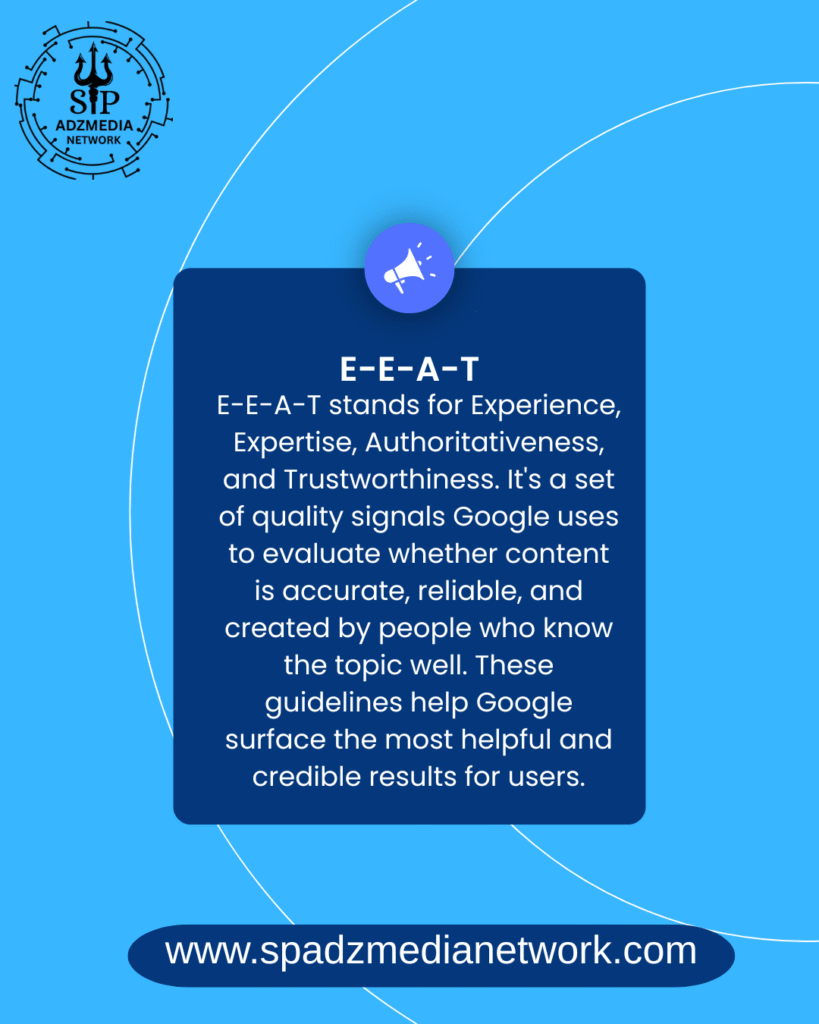
The search engine optimisation community will remember 2025 as the Google’s 2025 Updates for SEO From the depth of AI Overviews (AIOs) to the severity of the spam updates, every significant algorithm change, policy enforcement, and search feature rollout was intended to systematically remove rankings from unverified, scaled, or manipulative content, giving genuine E-E-A-T (Experience, Expertise, Authoritativeness, and Trustworthiness) a previously unheard-of value. 2025 has been a high-stakes lesson for SEO experts: visibility now depends on proving practical value
Google update 2025 for SEO gives lots of information for seo.
January–March: The Foundation Changes: Initial AI Overhaul and E-E-A-T Enforcement5
Clarity and enforcement marked the beginning of Google update 2025 for SEO.Google used the first quarter to improve its messaging and implement its new anti-spam technologies globally after making major Google update 2025 for SEO to the “Helpful Content System” in late 2024.
The Quality Rater Guidelines and the AI Content Dichotomy
The Search Quality Rater Guidelines (QRG), which are used by human evaluators to rate search results, were revised by Google in January. Determining the function of AI in content creation required this update. Google stated unequivocally that although AI is a helpful tool, human judgement and experience cannot be replaced by it.
Emphasis on Human Oversight: The QRG started to place a strong emphasis on the necessity of quantifiable human oversight, fact-checking, and original viewpoint—especially the “Experience” element of E-E-A-T.
Content generated at scale without this human layer—even if grammatically flawless—was flagged for lacking the depth and perspective needed to rank well.
- The Problem of Scaled Content Abuse: This enforcement laid the groundwork for the March Core Update. Sites that had heavily invested in scalable, formulaic content production (often using Generative AI to target thousands of long-tail keywords) saw their overall site authority diminish. The algorithmic signal wasn’t targeting the language model itself, but the lack of unique value proposition in the content mass.
The March 2025 Core Update the of Google update 2025 for SEO and New Spam Policies
The March Core Update (Mar 13–27) was arguably the most impactful of the year, operating in conjunction with an aggressive spam update rolled out simultaneously. This was Google’s statement on quality.
- Targeting Systemic Abuse: This update took direct aim at three types of manipulative content generation that had exploited Google’s systems:
- Expired Domain Abuse: The practice of purchasing domains with strong, legacy backlink profiles to host low-quality, often irrelevant, content. Google’s algorithms became far more sophisticated at identifying the disconnect between a domain’s historical reputation and its current content quality.
- There was more to scaled content abuse than just AI detection. It targeted any human or artificial intelligence (AI)-generated content produced at a scale designed solely to manipulate search rankings, often resulting in thin, repetitive pages with minimal actual value.
- Site Reputation Abuse (Parasite SEO) was the most controversial change. Google began punishing high-authority third-party websites (like major news publishers or educational portals) for placing poor-quality, usually affiliate-heavy content in their subdirectories in an effort to profit from the host domain’s reputation. The SEO community was forced to swiftly audit and remove such content in order to prevent algorithmic and manual penalties.
April – June: AI Overviews Solidify and Technical Excellence Refocuses
As the dust settled from the March volatility, Google continued to integrate its Gemini-powered AI Overviews (AIOs) deeper into the search experience, forcing SEOs to think about visibility beyond the traditional 10 blue links.
AI Overviews and the Zero-Click SERP
- By the middle of Google update 2025 for SEO , AIOs were showing up on a growing number of commercial and informational queries, essentially establishing a “zero-click” response box.
- The New Source Optimisation (Optimisation) Strategy: The emphasis switched from optimising for the click to optimising for the citation because AIOs usually pull data from several high-ranking sources. SEOs started setting priorities:
Concision and Clarity: presenting crucial information (definitions, lists, and a step-by-step breakdown) in a way that Google’s AI models can easily comprehend and consult.
- Entity-based SEO is the process of making sure that content appropriately and understandably demonstrates the connections between entities (people, places, things, and concepts). The use of precise terminology and structured data improves the AI’s comprehension of the authority chain.
- In order to guarantee that the AI can reliably parse the most valuable data points in the content and generate rich results, it is now more crucial than ever to use specific Schema markup (such as HowTo, FAQ, Article, and FactCheck).
- INP Rollout and Core Web Vitals Refocus
Although less erratic than the March Core Update, the June Core Update was a significant turning point for site performance.
- Core Web Vitals Integration: The “Page Experience” report in Search Console was formally retired by Google. This was a sign that the Core Web Vitals (CWV) are now fully integrated into the larger ranking systems as a baseline quality expectation, not that site speed was being degraded.
- Interaction to Next Paint (INP): The successful rollout of INP, replacing First Input Delay (FID), was fully completed. This metric, which measures the responsiveness of a page to user input, became a critical point of focus. SEOs had to work closely with developers to audit and optimize JavaScript execution and rendering, ensuring immediate feedback upon a user’s click or tap. Sites failing to provide a snappy, responsive user experience post-interaction saw noticeable drops.
July – September: The Ongoing Battle Against Spam and Data Clarity
The third quarter saw Google use its SpamBrain AI technology for targeted action, alongside crucial improvements to data transparency.
The August 2025 of Google update 2025 for SEO Spam Update
The August Spam Update (Aug 26–Sep 22) was a dedicated, laser-focused operation. Unlike a Core Update, which assesses the overall quality, this update was designed to flush out sophisticated, manipulative tactics that had survived the March purge.
- SpamBrain’s Evolving Power: SpamBrain, Google’s AI-driven anti-spam system, showed an increased ability to detect complex link networks and sophisticated attempts at keyword stuffing hidden within the content structure.
- The Long Tail of Link Spam: Google improved its ability to devalue link schemes and networks operating across multiple low-quality, siloed sites. Sites that relied on acquiring unnatural, bulk links—especially those using exact-match anchor text—continued to see devaluation. Recovery from this update often meant disavowing poor links and, more importantly, earning natural, authoritative links.
- Improvements to Search Console Data
Google update 2025 for SEO made major enhancements to Search Console Insights to assist the SEO community in navigating the combined effects of core updates and AIOs.
- Groups of Queries: Google created Query Groups after realising that a single SEO topic could be searched in dozens of different ways. By automatically grouping semantically related search queries together, this feature enables site owners to examine performance for topics rather than dispersed, individual keywords. The transition to entity- and topic-based content creation is ideally complemented by this modification. The new groupings enable the SEO to quickly determine whether clicks on a high-volume query simply switched to a slightly different, grouped query that was answered by an AIO if a site loses clicks on that query.
- October–November: Generative Search’s Future and Consolidation
Consolidating the year’s developments and getting ready for the subsequent stage of generative search were the main goals of the last few months.
- Combining SERP Features
Google persisted in its public endeavour to “simplify” the search results page. This implied.
- . This further emphasised the importance of original, high-quality media assets.
- The Author’s Changing Role and Expertise
- The emphasis on E-E-A-T had become more specific by November. Websites that could clearly show who wrote the content, their qualifications, and their track record of publishing high-quality information on the topic were rewarded more and more.
- Internal Linking as a Sign of Trust: It became crucial to have a clear, sensible, and pertinent internal linking structure. It functions as an algorithmic cue that the website is a coherent, knowledgeable authority on its subject in addition to being useful for user navigation. Content sprawl, a symptom of inadequate organisation and possibly inexperience, is indicated by a weak internal link structure.
- The Mandate of SEO for Google update 2025 for SEO : Be indispensable
- The Google update 2025 for SEO were structural modifications intended to reset the bar for online quality, not just small technical adjustments.Success with SEO in this new setting requires a change in strategy:
- Using auditing to confirm authenticity: Make sure that every piece of content demonstrates real experience by conducting a thorough audit.
- It is a liability if the content seems to be a rehashing or summary.
Q1. How does the August 2025 Spam Update affect SEO practices?
A1. This update cracked down on spammy link-building, doorway pages, thin content, and mass-produced AI posts. Sites using manipulative or low-value tactics saw major ranking drops.
Q2. What should creators do about AI-generated content?
A2. AI can assist, but Google prioritizes human value. AI-written posts must be reviewed, edited, and personalized to ensure they reflect real experience, accuracy, and insight — not generic information.
Q3. What is Google’s “Site Reputation Abuse” policy?
A3. This regulation was put into effect in 2025 and targets websites that manipulate rankings by using sponsored or subpar content on trusted domains. These days, such behaviour might lead to severe ranking penalties or deindexing..
Q4. In 2025, how will AI impact search results?
A4. Answers are now summarised immediately on search sites by Google’s AI Overviews (previously known as Search Generative Experience). Google can include reputable and well-structured websites in such summaries, even though this may result in fewer clicks.
Q5. What is the new emphasis on “Content Satisfaction Signals”?
A5. This means Google evaluates whether a page truly satisfies user intent — looking at dwell time, engagement, and bounce rate. Pages that fully answer questions and keep users engaged will rank higher.
Also Read :-Best SEO Services in Delhi by SP AdzMedia Network to Skyrocket Your Website’s Ranking
Best Digital Marketing Agencies in Delhi: SP AdzMedia Network Leads the Way
Best Digital Marketing Agency In Delhi-SP AdzMedia Network
Trends In Digital Marketing Top Start Up Companies in Delhi
Types OF Cotton Fabric – The remaining guide to cotton textures and weaves
Leave a Reply