
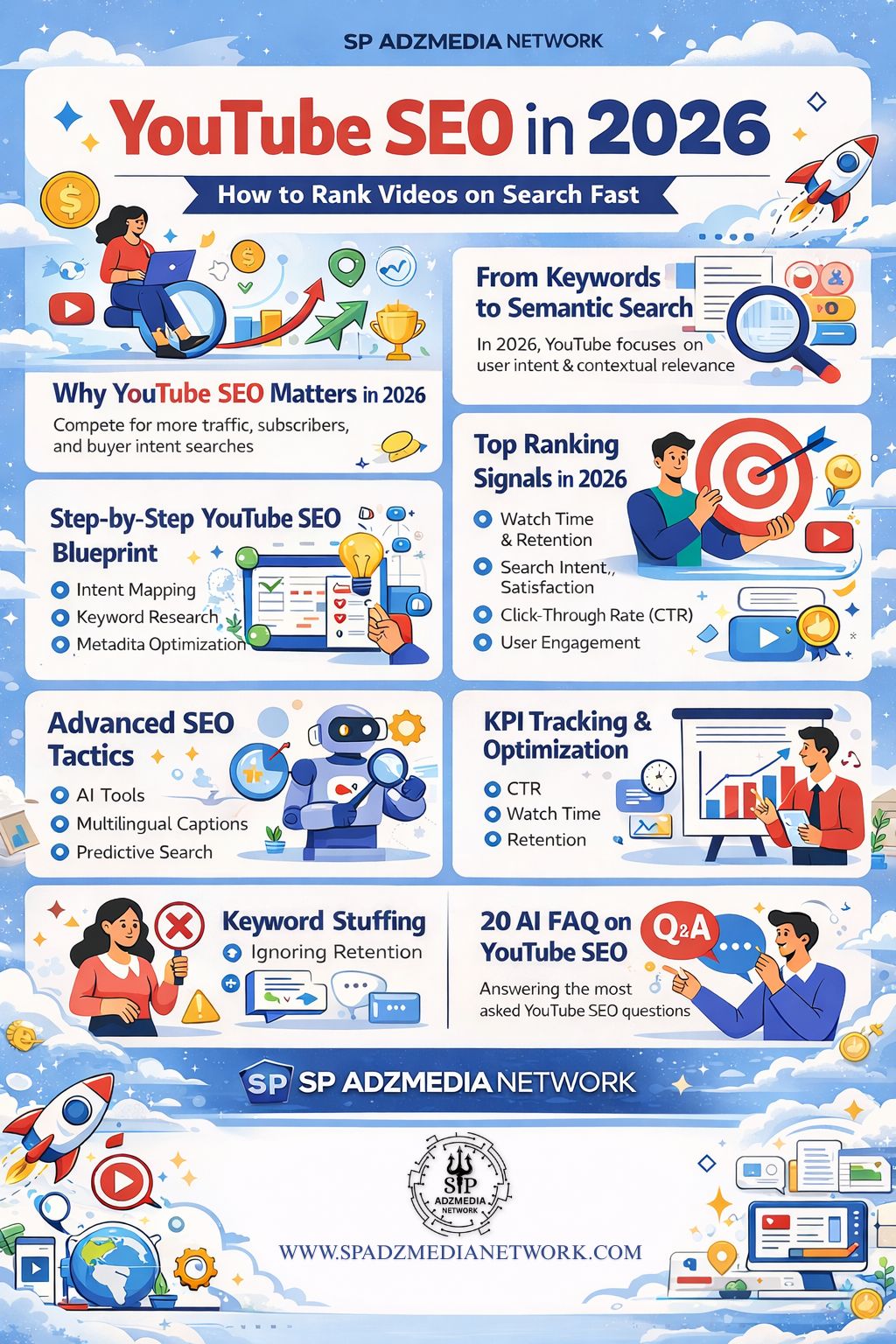
YouTube SEO in 2026 is no longer just a video hosting platform — it has fully matured into one of the world’s most powerful AI-driven search and recommendation systems. It combines web-scale indexing, semantic understanding, audience behavior prediction, and machine learning ranking models to serve the most relevant video for every query.
If your goal is organic discoverability, growth, and long-term authority on YouTube in 2026, mastering YouTube SEO isn’t optional — it’s fundamental.
This guide will take you from the basics to the most advanced ranking strategies, backed by real-world practices and future-proof algorithm behavior.
Table of Contents
1. Why YouTube SEO Still Matters in 2026
Even with short-form platforms rising, YouTube remains the top search destination for videos — especially for:
✔ How-to tutorials
✔ Product research & purchase decisions
✔ Skill learning & education
✔ Entertainment + deep dives
✔ Evergreen reference content
Unlike social-first scroll behavior (Reels, Shorts on other platforms), YouTube thrives on intent — the purpose behind a search. This means users come looking for specific answers, and the platform’s algorithm rewards videos that solve that intent most efficiently.
If your content satisfies search queries with clarity, engagement, and satisfaction, YouTube will rank it both in Search Results and Recommend Streams — leading to compounding visibility over time.
2. YouTube Search Evolution: From Keywords to Semantic Relevance
Historically, YouTube SEO was about:
Matching keywords in:
- Title
- Description
- Tags
But in 2026, YouTube has fully transitioned to an intent-and-behavior-driven search system, similar to how Google understands search queries today.
What Changed?
🧠 Semantic Search & Concept Understanding
YouTube now reads entire phrases and intent, rather than fragment keywords.
For example:
“iPhone video editing tips for travel vlogs” isn’t treated as a collection of keywords anymore — but as a searched “intent cluster” that describes:
- device (iPhone)
- purpose (editing)
- content type (travel vlogs)
- target skill level (tips)
This means your optimization must align with actual human questions, not just word combinations.
Session-Based Ranking
YouTube now assesses whether a video starts a session — meaning viewers continue watching other content afterward. Videos that extend session duration are perceived as providing high value and receive preference in both search and recommendation.
3. YouTube’s 2026 Ranking Signals (Deep Breakdown)
Here’s how the YouTube ranking system evaluates your video today, listed by influence:
Top Tier (Most Impactful)
1. Watch Time & Retention
Not just views — how long your audience stays matters most.
Average percentage viewed is a stronger signal than absolute views.
2. Search Intent Satisfaction
YouTube measures whether your video fully answers the search purpose.
This goes beyond duration — it looks at engagement behavior, whether viewers drop off, rewind, or skip.
3. Impression Click-Through Rate (CTR)
Thumbnails and titles must compel clicks — especially on relevant search results.
4. User Satisfaction Signals
Explicit feedback (likes, saves) and implicit signals (watch patterns, repeat views).
Mid Tier (Moderately Influential)
5. Engagement Signals
Comments, shares, Saves, “Watch Later” additions — especially early activity.
6. Session Duration Extension
Did your video lead viewers to watch more videos afterward?
7. Search Relevance
Semantic alignment of metadata with search phrases.
Secondary & Emerging Signals
8. Channel Authority
Cumulative performance boosts future videos — especially in the same topic cluster.
9. Viewer Loyalty
Returning viewers and subscribers amplify retention reliability.
10. Trend & Freshness
New content that catches a rising topic can rank faster.
11. External Signals
Links, embeds, social shares, and off-platform clicks indirectly influence visibility.
12. Multilingual Reach & Localization
Multilingual captions and region tags improve regional search performance.
4. The Definitive Step-by-Step YouTube SEO Blueprint
Below is a practical workflow used by top channel strategists in 2026.
Step 1 — Semantic Intent Mapping
Before keyword research, start with intent mapping — the foundation of modern YouTube SEO.
You’re no longer researching terms — you’re researching:
✔ What problem the user is solving
✔ What information they expect
✔ What format they prefer
✔ What outcome they want
Intent categories include:
- Informational
- Transactional
- Navigational
- Inspirational
- Problem/Solution
Example:
Query: “Best cheap cameras for travel 2026”
Intent: Transactional — comparing options and making a purchase decision
Your video must deliver:
- comparison charts
- price ranges
- pros/cons
- recommendations
Step 2 — AI-Enhanced Keyword & Topic Research
Use modern YouTube SEO tools (many AI-powered) that provide:
✔ search intent prediction
✔ topic clusters
✔ semantic relevance
✔ trending interest scores
✔ competitor performance measures
Forget old lists of keywords — instead generate:
📌 Intent phrases
📌 Semantic clusters
📌 Long-tail hybrid concepts
📌 Contextual phrases viewers use
Tip: Avoid bidding on super broad keywords like “travel videos” — focus on specific searches with clear intent, like:
“Best mirrorless cameras for travel YouTube 2026 beginners”
Step 3 — Metadata Optimization (Titles, Descriptions, Tags)
TITLE STRATEGY
✔ Keep main intent phrase toward the beginning
✔ Use natural grammar — YouTube reads meaning, not tokens
✔ Add year or timeliness where relevant (“2026”, “New Update”)
Example:
“Mirrorless Cameras for Travel YouTube (2026) — Best Budget & Pro Picks + How to Choose”
DESCRIPTION BEST PRACTICES
✔ First 2 lines matter most — include the intent phrase
✔ Add semantically related phrases — not keyword stuffing
✔ Add timestamps that define structure
✔ Add external references if helpful
Example structure:
In this video, I break down the BEST mirrorless cameras for travel YouTube creators in 2026 — from budget to pro models.
00:00 Intro
00:18 Budget Picks
01:30 Midrange Cameras
03:15 Features to Look For
05:20 Pro Level Recommendations
…
TAGS
✔ Use semantically related tags
✔ Include hybrid phrases that users might search
✔ Do not spam
Step 4 — Thumbnail Optimization Science
Thumbnails affect CTR — one of the top ranking factors.
Modern thumbnail practices:
✅ High-contrast visuals
✅ Clear human expression (eye contact, excitement, emotion)
✅ Text overlays — short and formulaic (e.g., “BEST 2026”, “SAVE $$$”)
✅ Consistent brand style
✅ Contrast with competitor thumbnails
Advanced tip: Use Thumbnail A/B testing within YouTube Studio to optimize CTR early.
Step 5 — Script And Structure that Maximize Retention
Retention signals have overtaken nearly every older ranking factor.
Video structure matters:
🟣 Hook (0–10 seconds)
Address the exact search intent. Example:
“Today I’m revealing the BEST mirrorless travel cameras for YouTube in 2026, and what to avoid staying tuned.”
🟣 Answer the query early
Deliver value immediately — don’t delay.
🟣 Segmented content
Add chapters and clear segments — this improves internal navigation and keeps watchers engaged.
🟣 Visual pacing
Use cuts, overlays, demo footage — not static talking heads.
🟣 Call to engagement
Ask relevant questions, invite comments, stimulate discussion.
Retention is not just length — it’s engaged attention.
Step 6 — Engagement Signals & Viewer Impact
What matters most here:
💬 Comment Depth
Longer comments with meaningful words are better than short emojis.
💾 Saves / Watch Later
Signal that viewers find your content valuable.
🔁 Shares & External Traffic
If viewers share outside YouTube, it indicates value.
Step 7 — Playlists, Segments & Channel Authority
Playlists help group related content, increasing session time and reinforcing topic authority.
Example playlist strategy:
“2026 SEO + Growth Tools for YouTube”
- YouTube SEO Deep Dive
- Analytics Benchmark Guide
- Retention Techniques
- Trend & Topic Mapping
Grouping commands YouTube AI to treat you as an authority in that topic.
Step 8 — Cross-Format Strategy: Long-Form + Shorts
In 2026, YouTube treats Shorts and long-form differently:
📍 Shorts
Ranking is based primarily on:
✔ Completion rate (full watch %)
✔ Rewatch rate
✔ Trend alignment
✔ Sound/music use
Shorts don’t rely on titles as much — they leverage visual and audio trends.
📍 Long-Form
Still relies on:
✔ Metadata
✔ Thumbnails
✔ Retention
✔ Engagement
✔ Satisfaction signals
Combining both helps amplify search visibility and recommendation feed penetration.
5. Advanced SEO Tactics That Actually Work
A — AI Tools for Future-Ready SEO
AI tools in 2026 do much more than find keywords. They can:
✔ Predict search intent vectors
✔ Analyze competitor top-ranked video behavior
✔ Suggest trending topic angles
✔ Forecast seasonal interest spikes
✔ Generate optimized title + description drafts
Important: AI should assist, not replace human judgment.
B — Semantic Topic Clusters
Rather than isolated videos, build topic ecosystems.
Example:
Topic: Fitness Equipment for Beginners 2026
Content pieces:
- Best Entry-Level Dumbbells
- Affordable Home Gym Setups
- Comparison of Treadmills under ₹30,000
- Mistakes Beginners Make
- How to Build Muscle on a Budget
This signals to YouTube that you are a topic authority — boosting all related videos in search.
C — Multilingual SEO Indexing
YouTube indexes subtitles — and multilingual captions help you tap into multiple regional search patterns.
Best practice:
✔ Add English captions
✔ Add at least two other major languages (Hindi + Spanish, or French + Arabic depending on your audience)
Localized descriptions and titles improve local search visibility.
D — Hyper-Local Optimization
YouTube now understands location intent — especially for region-based queries.
Examples:
- “Best laptops in India under ₹50,000”
- “Travel cameras available in Delhi tech stores”
- “Yoga routines for Indians 40+”
Use:
✔ regional terms in titles/descriptions
✔ localized metadata
✔ language variants
E — Predictive Search Optimization
Some tools can predict emerging search topics based on platform trends across Google, TikTok, IG, and YouTube.
Example:
If Google Trends suggests “AI video editing on mobile” is rising rapidly, create content before the competition.
6. KPI Tracking, Testing & Optimization
Core YouTube SEO KPIs
📌 Search Traffic — how many visitors come from search
📌 Impression CTR — clickability increase when your thumbnails and titles are catchy and attractive
📌 Average % Viewed — core retention metric
📌 Relative Audience Retention — compared to similar videos
📌 Session Time Contribution — how much your video influences continued watch
📌 Engagement Signals — comments, shares, saves
YouTube SEO Experiment Framework
Use controlled experiments:
✔ Thumbnail swapping
✔ Title variants
✔ Early hook variations
✔ Description adjustments
✔ Playlist structure changes
Run tests over at least 48–72 hours to gather reliable data.
7. YouTube SEO Mistakes to Avoid in 2026 (Most Common)
❌ Treating keyword stuffing as SEO
❌ Ignoring watch time behavior
❌ Focusing solely on views
❌ Skipping timestamps and chapters
❌ Underestimating thumbnails
❌ Uploading without strategic intent
❌ Copying competitors blindly
❌ Neglecting engagement and satisfaction
❌ Neglecting localization and multilingual indexing
❌ Not refining content based on analytics
8. Final Strategic Playbook (Actionable Checklist)
✔ Map search intent before topics
✔ Use AI tools for semantic clusters
✔ Optimize titles for intent, not keywords
✔ Write compelling, context-rich descriptions
✔ Use high-contrast thumbnails
✔ Structure videos for retention
✔ Add timestamps & chapters
✔ Build playlists as topic clusters
✔ Add multilingual captions
✔ Run experiments & analyze KPIs
✔ Iterate based on behavior, not assumptions
✔ Combine Shorts + long-form strategy
✔ Track session time influence
✔ Avoid SEO shortcuts
20 Most Asked AI FAQ (2026 Edition)
1. What’s the single most important ranking factor in 2026?
Audience retention and watch time (% viewed). YouTube prioritizes videos where viewers stay engaged longer — this signals relevance and satisfaction.
2. Are keywords still relevant?
Yes — but now as part of intent clusters and semantics, not just single words. YouTube understands meaning, context, and behavior.
3. How fast can videos rank today?
If a video satisfies intent with strong early engagement, it can rank within hours, especially for specific queries.
4. Do long videos rank better?
Not necessarily. What matters is how much attention and watch time the video earns.
5. How does YouTube measure “satisfaction”?
Through engagement signals like likes, saves, comments, and watch patterns (rewatches, completion, session starts).
6. Should I focus more on Shorts or long-form?
Both. Shorts improve visibility and can drive search discovery, while long-form ranks in deeper user intent queries.
7. How important are playlists for SEO?
Very. They help build content clusters, increasing session time and topical authority.
8. Can captions improve SEO?
Yes — especially multilingual captions that open your content to regional search queries.
9. Do tags still matter?
Moderately. Tags help clarify context but don’t carry as much weight as titles, descriptions, and retention.
10. What’s an ideal retention percentage?
While it varies by niche, anything above 50–60% for long-form videos and 70%+ for shorter content is strong.
11. How do I analyze search intent data?
Use modern SEO tools that analyze semantic clusters and AI intent patterns, not just raw keyword volume.
12. Should I change titles after publishing?
Yes, if analytics suggest a mismatch between intent and actual search behavior.
13. How do external shares affect rankings?
Indirectly. They drive traffic, engagement, and session time — which influence search visibility.
14. Does YouTube discriminate between old and new content?
Older videos can still rank if they are continually satisfying search queries — especially evergreen tutorials or informational content.
15. What’s the biggest SEO myth?
That high subscriber count alone guarantees rankings — content relevance and user satisfaction matter more.
16. How often should I upload?
Quality beats quantity. But a consistent schedule improves channel authority.
17. Is community engagement a ranking factor?
Yes — comments, replies, and community interactions amplify satisfaction signals.
18. What’s semantic clustering?
Grouping related content so YouTube sees your channel as an authority on a topic.
19. How does watch time affect recommendations?
Videos with good watch time are more likely to be recommended in the home feed and suggested video slots.
20. Can I rank without subscribers?
Yes — especially for specific search queries where retention and engagement signal relevance.
Also Read :-Best SEO Services in Delhi by SP AdzMedia Network to Skyrocket Your Website’s Ranking
Best Digital Marketing Agencies in Delhi: SP AdzMedia Network Leads the WayBest Digital Marketing Agency In Delhi-SP AdzMedia NetworkTrends In Digital MarketingTop Start Up Companies in Delhi Backlink Creation Services in Delhi Explore our SEO services in Rohini Backlink Creation Services in Delhi AI SEO Optimization E-Commerce SEO 2025: The Ultimate Guide by SP AdzMedia Network SEO vs AEO vs GEO Latest Google Ads Strategy for 2026 Best Startup Ideas for Business in 2026 — The Ultimate Guide How to Start a Print-on-Demand T-Shirt Business in 2026 (Powered by AI Innovation) 200+ Travel Blog Comment Sites 2026 Local SEO Services by SP AdzMedia Network Top AI Startup Ideas in India 2026 Local SEO Services by SP AdzMedia Network
Our Social Media Handles: Instagram Linkedin X Pinterest Blogger YouTub
Leave a Reply