
Table of Contents
Comprehension: What is Google Ads?
What is Google Ads, If you ever searched for goods, services, a business, or a solution in Google, there is a good chance that you saw ads above or below search results. These ads usually are made via Google Ads.
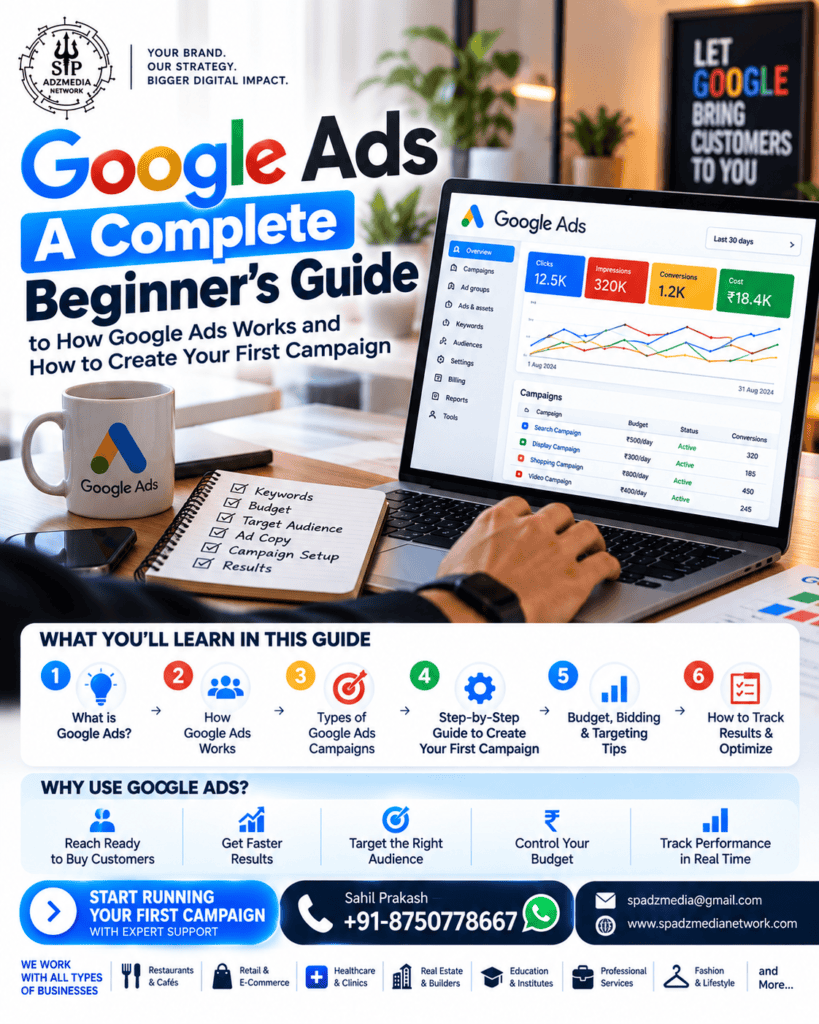
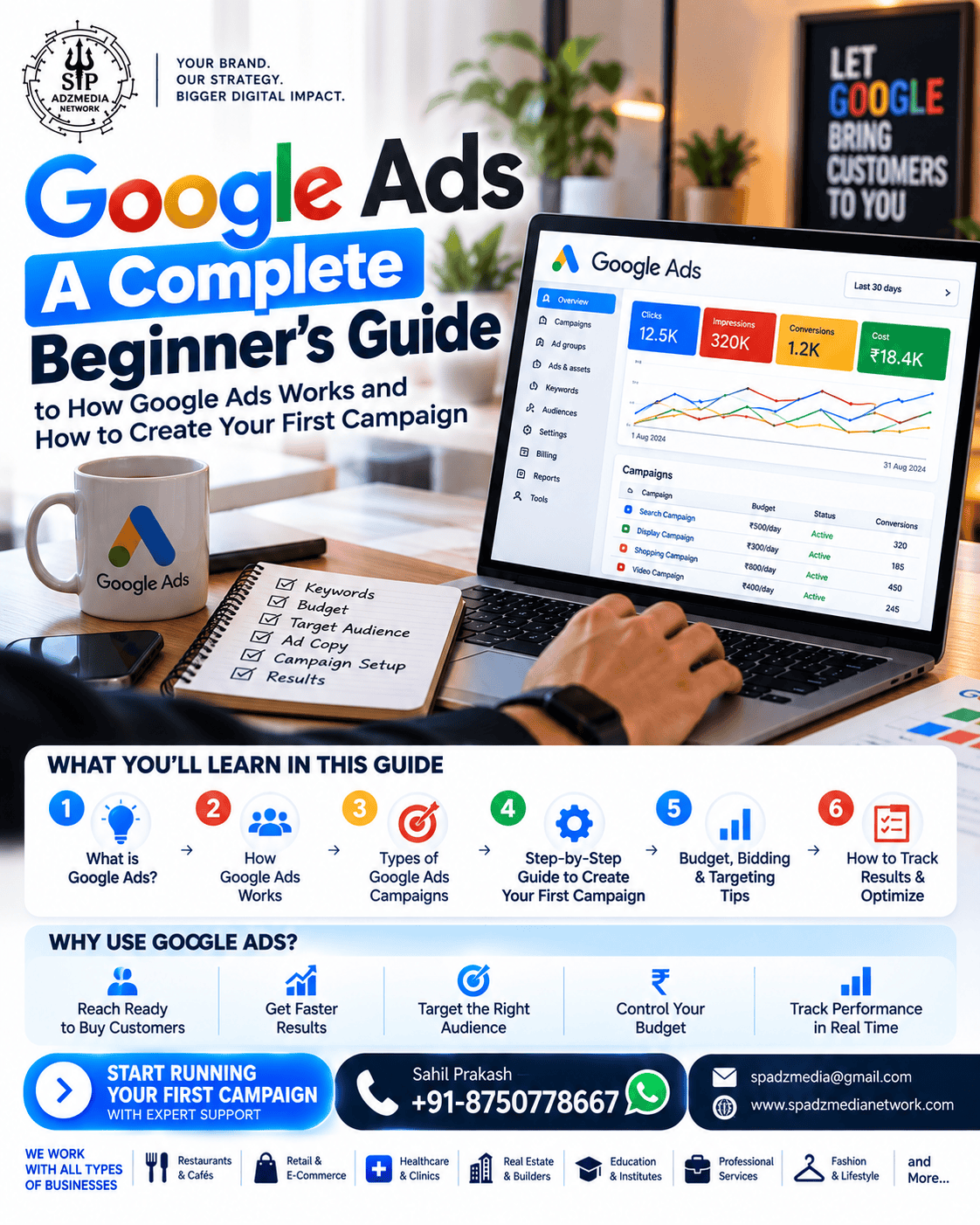
But how it works, what is Google Ads?
The Google Ads service is a paid service from Google that enables organizations to promote their products, services, websites, apps, and other possibilities. Google advertising has become more effective than traditional advertising methods since this advertising method allows businesses to advertise market products and services to a certain audience based on their search queries and geographical locations.
For example, imagine someone searches:
“Digital Marketing Agency in Delhi”
When a digital marketing agency focuses on potential customers through the right searches, it is important that they can provide those interested in a specific service with an ad.
This feature makes Google Ads an effective tool for businesses that wish to target customers who are interested in a commercial service.
However, Google Ads is more than just a venue where the highest payer wins.
There are several variables that affect how well a campaign performs.
- Bid
- Ad relevance
- Ad quality
- Search context
- Competition
- Targeting
- Landing-page experience
- Campaign objective
- Conversion data
Therefore, successful management of Google Ads entails a lot more than placing an ad and liquidating funds in the account.
To run an effective Google Ads campaign one has to have strategic planning, market research, audience targeting, results monitoring, testing, and continuous improvement skills.
Google Ads is an online paid advertising platform that helps businesses reach their target customers via Google’s various ads.
- Generate leads
- Increase website traffic
- Generate sales
- Receive phone calls
- Promote products
- Promote applications
- Reach local customers
- Build brand awareness
- Increase enquiries
- Promote specific offers
For example:
- A dental clinic may use Google Ads to generate appointment enquiries.
- A retail business may utilize Google Ads for marketing their products.
- A restaurant might use Google Ads for connecting with clients in a certain location.
- A law firm might use ads to provide its legal services.
- A digital marketing agency can employ Google Ads for advertisement of its services.
The campaign strategy must be established based on the real aim of the business.
How Does Google Ads Work?
Google Ads mechanism needs to be understood before a firm starts using the service for the advertising budget.
Whenever a search is conducted by a user from Google, there is a chance that other firms will also be interested in displaying their ads to the user. Google uses the method of advertising auction to determine which ads will be eligible.
It should be noted that the auction process does not depend solely on the willing amount.
These can include:
- Bid
- Ad relevance
- Ad quality
- Landing-page experience
- Search context
- Competition
- Campaign settings
- Expected impact of advertising assets
This means a business should not assume that increasing the budget automatically guarantees better advertising performance.
A properly structured campaign should connect the entire customer journey.
For example:
Search Query
↓
Relevant Keyword
↓
Relevant Advertisement
↓
Relevant Landing Page
↓
Customer Action
This relationship is important because the customer should receive a consistent message from the initial search through the final conversion.
Why Do Businesses Use Google Ads?
Google Ads can serve different purposes depending on the business model.
1. Lead Generation
Lead generation is one of the most common objectives for service-based businesses.
Advertisements can be used to motivate consumers to:
- Submit enquiry forms
- Call the business
- Request a consultation
- Book an appointment
- Request a quotation
- Schedule a meeting
For example, a lawyer may run advertisements for people searching for legal services in Delhi.
A dental clinic may advertise for people searching for dental treatment.
A digital marketing agency may advertise for businesses looking for Google Ads services.
2. Website Traffic
Using Google Ads allows companies to direct traffic from relevant users on the internet to their sites.
Rather than just depending on their natural search traffic, paid advertising opens the door to more prospects for customers to be directed to certain sections of the website.
The important point is that traffic should be relevant.
Getting thousands of visitors who have no interest in the product or service may not provide meaningful business value.
3. Online Sales
E-commerce businesses can use Google Ads to promote their products and encourage customers to visit product pages and complete purchases.
Advertising allows businesses to link their products with those individuals who are looking for or interested in their products.
4. Local Customer Acquisition
Google Ads can be useful for businesses that operate within specific geographic areas.
Examples include:
- Dentist in Rohini
- Lawyer in Delhi
- Restaurant in Rohini
- Digital Marketing Agency in Delhi
- Real Estate Consultant in Delhi NCR
- Wedding Planner in Delhi
- Dental Clinic in Delhi
- Home Renovation Services in Delhi
For local businesses, location targeting and relevant search intent can be important parts of campaign planning.
5. App Promotion
Businesses that have mobile apps can use advertisements to persuade:
- App installations
- App engagement
- Other valuable in-app actions
6. Brand Awareness
Google advertising can also be used to introduce a business or product to new audiences.
The objective in this case may be broader awareness rather than an immediate purchase.
Types of Google Ads Campaigns
Various different types of campaigns are provided by Google Ads to target some particular advertising aims.
The choices and functionalities available will vary on the basis of such factors as the account, location, industry as well as campaign objective.
1) Search Campaigns
Search campaigns are initiated to target individuals when they are searching for products, services, or some needed information on Google.
For example:
- “Google Ads Company in Delhi”
- “Best Dental Clinics in Rohini”
- “Top Wedding Planners in Delhi”
- “Divorce Attorneys in Delhi”
Search advertising is particularly effective when the target customers are in the process of searching for certain services or goods.
2) Display Campaigns
Display advertising can assist companies in reaching users on various available websites and applications.
Display advertising can be useful for:
- Brand awareness
- Audience reach
- Remarketing
- Product promotion
The goal may be to keep a business visible to potential customers even when they are not actively searching for a particular service.
3. Shopping Campaigns
Shopping advertising is relevant for online retailers.
Product-centric advertisement may carry information including:
- Product image
- Product name
- Price
- Store information
- Product details
This can help potential customers understand a product before visiting the website.
4. Video Campaigns
Video campaigns can help businesses advertise through eligible video placements.
Businesses may use video advertising for:
- Awareness
- Consideration
- Website traffic
- Leads
- Sales
Video can also help businesses communicate information visually instead of relying only on text.
5. App Campaigns
App campaigns are designed to help businesses promote mobile applications.
They can be used to encourage:
- App installations
- App engagement
- Other valuable actions inside an application
6. Performance Max Campaigns
Performance Max is Google Ads’ goal-oriented campaign format that helps advertisers access customers through one single campaign across all Googles advertising networks.
No matter if the campaign follows preset campaign requirements and configuration, it will still reach:
- Google Search
- YouTube
- Gmail
- Maps
- Gmail
- Google Discover
To achieve pre-determined business goals through Performance Max, automation and Google AI have been widely used.
In light of the role automation plays in this process, the ads managers need to pay extra attention to their objectives and correct tracking.
Keyword Research in Google Ads
- Digital marketing agency Delhi
- Google Ads agency Delhi
- PPC agency Delhi
- Digital marketing services Rohini
- Google Ads management Delhi
- Google advertising agency Delhi
However, keyword selection should not be based only on search volume.
Search intent is equally important.
For example:
“What is Google Ads?”
is primarily an informational search.
Someone searching:
“Google Ads agency in Delhi”
may have a stronger commercial intent.
Both searches are related to Google Ads, but the user may have a completely different purpose.
Therefore, keyword research should consider:
- Search intent
- Relevance
- Customer needs
- Competition
- Business objective
- Geographic relevance
- Potential conversion value
Google Ads Keyword Match Types
Google Ads provides different keyword matching options.
The major match types are:
- Broad Match
- Phrase Match
- Exact Match
Broad Match
Broad match serves in allowing ads to reach more searches related to the definitions of keywords.
Despite providing a larger reach, broad match requires vigilant monitoring.
Phrase match
Phrase match, however, gives control while allowing ads to reach searches with similar intentions attached to keywords.
Exact match
Exact match, on the other hand, offers better control of each of the ads on top of being considered for searches that are similar in meaning and intentions.
Choosing the type of match depends on the requirements of the campaign as well as the need to find a better balance between reach and control.
Negative keywords
Negative keywords make it possible to avoid showing ads, when it is unnecessary.
For example, a business offers services of paid digital marketing, but it does not provide free ones.
The business may consider:
“free”
as a negative keyword when appropriate.
Other possible examples could include:
- Jobs
- Salary
- Course
- Training
- Free
However, negative keywords should never be added blindly.
They should be selected according to the actual business model and campaign strategy.
The main purpose is to reduce irrelevant traffic and improve advertising budget efficiency.
What Is Ad Relevance?
Relevance in advertising can be defined as how well the advertisement fits to what the potential customer has been searching for.
For example, suppose someone searched
“Luxury Wedding Venue in Delhi”
In that case, an advertisement solely dealing with luxury wedding venue in Delhi will be more relevant than a generic advertisement conveying other wedding services.
In a successful campaign, it is important to maintain consistent correlations between:
Keyword
↓
Advertisement
↓
Landing Page
Such consistency enables more straightforward path for customers.
What is Landing Page?
Landing page is the page users reach by clicking on an advertisement.
Landing page is important because the advertisement creates an expectation.
For example, if advertisement says:
“Google Ads Management Services in Delhi”
the landing page should clearly explain Google Ads management services.
A good landing page should:
- Match the advertisement
- Clearly explain the offer
- Provide useful information
- Load efficiently
- Work properly on mobile
- Build trust
- Have a clear call to action
- Make contacting the business easy
- Make purchasing or booking easy when applicable
Sending every advertisement visitor to the homepage may not always provide the most relevant experience.
A dedicated landing page can sometimes provide a more focused customer journey.
How Much Does Google Ads Cost?
The one most asked question among novices is:
“How much does Google Ads cost?”
There is no single fixed price.
Google Ads costs can vary based on:
- Industry
- Keyword competition
- Location
- Customer demand
- Campaign type
- Bidding strategy
- Search intent
- Campaign settings
- Advertising competition
- Landing-page experience
Two businesses can advertise similar services and still have completely different costs.
For example, a highly competitive service in a major city may require a different advertising budget compared with a less competitive service in a smaller location.
Therefore, businesses should not look at advertising cost in isolation.
They should also consider:
- Cost per Lead
- Cost per Customer
- Customer Value
- Profit Margin
- Return on Advertising Spend
What Is a Google Ads Bidding Strategy?
A bidding strategy determines how Google uses the advertising budget in relation to the campaign objective.
Depending on the campaign and available options, bidding can focus on objectives such as:
- Clicks
- Conversions
- Conversion value
- Visibility
The appropriate strategy depends on:
- Campaign objective
- Business goal
- Conversion data
- Campaign type
- Account setup
For example, a business focused on generating leads may evaluate its campaign differently from a business focused on online product sales.
Therefore, bidding should always be connected to the actual business objective.
What Is Conversion Tracking in Google Ads?
Conversion tracking is one of the most important parts of performance-based advertising.
Clicks and impressions can tell you how many people interacted with your advertisements.
But businesses also need to know:
Did those visitors actually take a valuable action?
A conversion can be:
- Purchase
- Lead form submission
- Phone call
- Appointment
- Booking
- Consultation request
- Sign-up
- Other valuable customer action
For example:
A company spends:
₹10,000
on Google Ads.
The campaign generates:
20 enquiries
Cost per lead:
₹10,000 ÷ 20 = ₹500
If 5 of those enquiries become paying customers:
₹10,000 ÷ 5 = ₹2,000 per customer
This is why businesses should not judge campaigns only by clicks.
The real question is:
What business result did the advertising generate?
The easiest way to have your first Google ads campaign up and running
Creating a Google Ads campaign becomes much easier when you follow a structured process.
Step 1: Define Your Business Goal
Start by deciding exactly what you want.
Examples:
- Generate leads
- Generate sales
- Increase website traffic
- Receive phone calls
- Promote an app
- Build awareness
A clear objective should guide the rest of the campaign.
Step 2: Understand Your Customer
Ask:
- Who is my customer?
- Where are they located?
- What problem are they trying to solve?
- What are they searching for?
- What product or service do they need?
- Why should they choose my business?
The answers can help shape your keywords, advertisement, landing page, and targeting.
Step 3: Choose the Campaign Type
Choose a campaign type based on your objective.
For example:
- A local service business may consider Search advertising.
- An e-commerce business may consider Shopping-focused advertising.
- A business focused on broader automated reach may consider other campaign types depending on its goals.
Step 4: Select Your Location
Keep in mind that location targeting should correspond to the location of your customers.
You may target:
- Specific areas
- Cities
- Multiple cities
- States or regions
- Countries
A local business should carefully consider whether it really needs to advertise outside its service area.
Step 5: Research Keywords
Select important and relevant keywords if you own a business. Do not aim for selecting keywords with high search volumes.
Ask yourself the question: “Would the customer behind this query actually buy from me?”
Step 6. Add Negative Keywords
Look at irrelevant keywords in your sector.
This can help prevent advertising budget from being spent on unwanted traffic.
Step 7: Write Your Advertisement
A good advertisement should clearly communicate:
- What you offer
- Main benefit
- Who you help
- Relevant location
- Call to action
Example:
Google Ads Management in Delhi
Build Structured Campaigns to Generate Relevant Business Leads
Get a Consultation
The advertisement should accurately represent the actual service.
Step 8: Set Your Budget
Choose a budget that your business can realistically maintain.
Consider:
- Expected lead volume
- Cost per lead
- Conversion rate
- Customer value
- Profit margin
- Sales capacity
Starting with a manageable budget can allow a business to gather performance data before making larger decisions.
Step 9: Set Up Conversion Tracking
Trace down key actions towards your business.
For example:
- Lead Form → Conversion
- Phone Call → Conversion
- Purchase → Conversion
- Booking → Conversion
- Consultation → Conversion
Step 10: Review and Launch
Before launching, review:
- Campaign objective
- Location
- Keywords
- Negative keywords
- Advertisement
- Landing page
- Budget
- Bidding strategy
- Conversion tracking
- Billing setup
After reviewing everything, the campaign can be submitted for review and launched when eligible.
How to Optimize Google Ads
Launching a campaign is only the beginning.
Google Ads should be monitored regularly.
Important areas include:
- Search terms
- Keywords
- Ad performance
- Conversion rate
- Cost per conversion
- Location performance
- Device performance
- Landing pages
- Budget usage
- Conversion quality
Review Search Terms
Search-term analysis can help identify irrelevant searches.
If irrelevant searches are consuming budget, consider improving targeting or adding relevant negative keywords.
Review Keywords
Look at which keywords are producing valuable results.
A keyword receiving many clicks but producing no meaningful conversions may need attention.
Improve Ad Copy
Test different:
- Headlines
- Descriptions
- Benefits
- Offers
- Calls to action
The objective here is not merely driving traffic.
The aim is not merely achieving traffic of better quality.
Optimize Landing Pages
If users are clicking but not converting, investigate the landing page.
Check:
- Page speed
- Mobile experience
- Message relevance
- Trust signals
- CTA visibility
- Contact form
- Offer clarity
Review Locations
Different geographic areas can produce different results.
Identify where valuable enquiries and customers are coming from.
Review Devices
Review performance across:
- Mobile
- Desktop
- Tablet
Your website should be doing well.
Common Google Ads Mistakes Beginners Make
1. Choosing Irrelevant Keywords
High search volume does not necessarily mean high-quality traffic.
2. Ignoring Negative Keywords
Irrelevant searches can consume advertising budget.
3. Targeting Too Many Locations
Advertising outside your actual service area can result in irrelevant traffic.
4. Sending Everyone to the Homepage
A specific landing page may be more relevant to the advertisement.
5. Not Tracking Conversions
Without conversion tracking, it becomes difficult to understand the actual business impact.
6. Focusing Only on Clicks
Clicks are not customers.
7. Changing Campaigns Too Frequently
Frequent changes without sufficient data can make campaign evaluation difficult.
8. Ignoring Mobile Users
A poor mobile experience can create problems even when advertisements are performing well.
9. Ignoring Landing Page Quality
A slow or confusing landing page can affect the customer journey.
10. Spending Without Reviewing Performance
Advertising should be monitored regularly to understand where the budget is being used and what results are being generated.
Google Ads for Local Businesses
Local businesses can use Google Ads to target customers within specific geographic areas.
Examples include:
- Dentist in Rohini
- Lawyer in Delhi
- Restaurant in Rohini
- Digital Marketing Agency in Delhi
- Real Estate Consultant in Delhi NCR
- Wedding Planner in Delhi
- Dental Clinic in Delhi
- Home Renovation Services in Delhi
A local campaign should connect:
Location + Service + Search Intent + Advertisement + Landing Page + Conversion Tracking
For example, if a business provides services only in Rohini, the campaign strategy should take that service area into consideration.
Google Ads vs SEO
Google Ads and SEO are different digital marketing methods.
Google Ads
Google Ads is paid advertising.
Businesses allocate an advertising budget to promote their products and services through paid placements.
Google Ads can be useful when a business wants to create paid visibility for specific products, services, audiences, or locations.
SEO
SEO focuses on improving organic visibility in search engines.
SEO generally involves:
- Content
- Technical optimization
- Website structure
- Search intent
- Relevance
- Authority
- Competition
SEO generally takes a longer-term approach.
Google Ads and SEO can be used together.
For example:
Google Ads = Paid Visibility
SEO = Organic Visibility
A business may use both as part of a broader digital marketing strategy.
Is Google Ads Good for Small Businesses?
Google Ads can be useful for small businesses, but results depend on several factors.
Important considerations include:
- Product or service demand
- Competition
- Customer value
- Average order value
- Profit margin
- Conversion rate
- Cost per customer
- Website quality
- Campaign management
- Sales capacity
A small business should not judge Google Ads only by impressions.
It should evaluate whether advertising is helping generate valuable customers at a sustainable acquisition cost.
What Is Google Ads? Final Answer
So, what is Google Ads?
Google Ads is Google’s paid online advertising platform that allows businesses to promote products, services, websites, applications, and offers to potential customers.
It can be used for:
- Lead generation
- Sales
- Website traffic
- Calls
- Local customer acquisition
- App promotion
- Brand awareness
But successful Google Ads management requires more than simply setting a budget.
A structured campaign generally follows:
Business Objective
↓
Customer Research
↓
Keyword Research
↓
Targeting
↓
Relevant Advertisement
↓
Landing Page
↓
Bidding
↓
Conversion Tracking
↓
Optimization
The ultimate objective should not simply be:
“Get more clicks.”
A stronger business objective is:
“Generate more relevant customers at a sustainable cost.”
15 Frequently Asked Questions About Google Ads
1. What Is Google Ads?
Google Ads is Google’s paid online advertising platform used by businesses to promote products, services, websites, applications, and offers.
2. How Does Google Ads Work?
Google Ads uses an advertising auction to determine which eligible advertisements can appear. Bidding, relevance, ad quality, targeting, competition, search context, and other factors can influence the result.
3. How Much Does Google Ads Cost?
There is no fixed Google Ads cost. Pricing depends on factors such as competition, industry, keywords, location, campaign type, bidding strategy, and search demand.
4. Is Google Ads Free?
Google Ads is a paid advertising platform. Companies have to spend money on promotion.
5. Are Google Ads Effective for Small Scale Businesses?
It can be useful when campaigns have clear objectives, relevant targeting, appropriate budgets, strong landing pages, and proper conversion tracking.
6. What Are Google Ads Keywords?
Keywords are words or phrases advertisers use to help connect advertisements with relevant searches.
7. What Are Negative Keywords?
Negative keywords help prevent advertisements from appearing for unwanted or irrelevant searches.
8. What Is a Google Ads Conversion?
A conversion is a valuable action generated after an advertising interaction, such as a purchase, call, form submission, booking, or appointment.
9. Why Is Conversion Tracking Important?
Conversion tracking helps businesses understand whether their advertising is generating meaningful actions rather than just clicks.
10. What Is Performance Max?
Performance Max is a type of campaign that is aimed at advertising and reaching customers through different advertising channels on the Google platforms.
11. What Is the Main Difference Between Google Ads and SEO?
Google Ads is a paid service whereas SEO is concerned with the organic search of a website.
12. Can Local Businesses Use Google Ads?
Yes. Businesses can structure campaigns around specific locations and services depending on their objectives and service areas.
13. How Do I Start Google Ads?
Start by defining your business objective, understanding your customer, selecting a campaign type, researching keywords, setting targeting, creating advertisements, selecting a budget, and configuring conversion tracking.
14. How Can I Reduce Wasted Google Ads Spending?
Businesses can improve targeting, review search terms, use relevant negative keywords, improve ad relevance, use relevant landing pages, track conversions, and regularly analyze campaign performance.
15. How Can I Improve Google Ads Performance?
Regularly review keywords, search terms, advertisements, conversions, cost per conversion, locations, devices, landing pages, and budget usage. Make improvements based on actual campaign data.
Google Ads Beginner Checklist
Prior to starting up your first campaign, ensure you possess the;
☐ Clear campaign objective
☐ Defined target customer
☐ Correct location targeting
☐ Relevant keyword research
☐ Negative keyword strategy
☐ Relevant advertisement copy
☐ Strong landing page
☐ Mobile-friendly website
☐ Appropriate budget
☐ Suitable bidding strategy
☐ Conversion tracking
☐ Analytics setup
☐ Campaign monitoring plan
☐ Regular optimization process
Final Google Ads Takeaway
Google Ads can become an important part of a business’s digital marketing strategy when it is planned and managed properly.
A successful campaign is not built around one element.
It requires a combination of:
- Strategy
- Keyword Research
- Targeting
- Relevant Ad Copy
- Landing Page Optimization
- Budget Management
- Conversion Tracking
- Performance Analysis
- Continuous Optimization
Before investing heavily in advertising, businesses should first understand their target customer, define their objective, determine what action they want users to take, and decide how success will be measured.
The focus should be on relevant traffic, meaningful conversions, and sustainable customer acquisition, rather than simply generating a large number of clicks.
Need Help With Google Ads?
SP ADZMEDIA NETWORK provides digital marketing and Google Ads support for businesses looking to build structured and measurable advertising campaigns.
Our Google Ads Services
- Google Ads Campaign Setup
- Keyword Research
- Campaign Structure
- Search Ads Management
- Location Targeting
- Negative Keyword Research
- Advertisement Copywriting
- Landing Page Strategy
- Conversion Tracking
- Campaign Monitoring
- Performance Optimization
- Reporting
SP ADZMEDIA NETWORK
Sahil Prakash
Phone: +91-8750778667
Email: spadzmedia@gmail.com
Website: www.spadzmedianetwork.com
Rohini, Delhi | PAN India
START WITH THE RIGHT STRATEGY.
OPTIMIZE WITH REAL DATA.
FOCUS ON REAL BUSINESS RESULTS.
Also Read :-Best SEO Services in Delhi by SP AdzMedia Network to Skyrocket Your Website’s Ranking
Best Digital Marketing Agencies in Delhi: SP AdzMedia Network Leads the WayBest Digital Marketing Agency In Delhi-SP AdzMedia NetworkTrends In Digital MarketingTop Start Up Companies in Delhi Backlink Creation Services in Delhi Explore our SEO services in Rohini Backlink Creation Services in Delhi AI SEO Optimization E-Commerce SEO 2025: The Ultimate Guide by SP AdzMedia Network SEO vs AEO vs GEO Latest Google Ads Strategy for 2026 Best Startup Ideas for Business in 2026 — The Ultimate Guide How to Start a Print-on-Demand T-Shirt Business in 2026 200+ Travel Blog Comment Sites 2026 Local SEO Services by SP AdzMedia Network Top AI Startup Ideas in India 2026 Local SEO Services by SP AdzMedia Network YouTube SEO in 2026 Ranking Your Website Without Backlinks in 2026 SEO vs PPC vs SMM Top 100+ Meta Ads Interview Questions 2026 Google Trends for Keyword Research Google Search Console
Our Social Media Handles: Instagram Linkedin X Pinterest Blogger YouTube
Leave a Reply